
Why Group Therapy May Be the Most Powerful Therapy You've Never Considered

Key Takeaways
Most people assume healing happens one-on-one with a therapist, but many struggles tied to relationships, trust, rejection, and connection are best explored with others. Interpersonal group psychotherapy uses the real relationships that form between group members as the engine for change. Instead of only talking about relationship patterns, members notice and reshape them in real time, in a psychologically safe space with a therapist's guidance. Group therapy can stand on its own or work alongside individual or couples therapy.
Why Group Therapy May Be the Most Powerful Therapy You've Never Considered
Most people begin therapy believing that healing happens through a one-on-one conversation with a therapist. For many concerns, individual therapy is an excellent place to start.But what if some of the very struggles that bring you into therapy—difficulty trusting others, fear of rejection, conflict in relationships, loneliness, people-pleasing, feeling misunderstood, or struggling to be your authentic self—can't be fully explored or healed in the warm and cozy confines of the patient-therapist relationship? Relationships create many of our deepest wounds. It makes sense that they can also become one of our greatest opportunities for healing. Healing through relationships is the foundation of interpersonal group psychotherapy.
Interpersonal Group Psychotherapy Doesn't Just Talk About Relationships—It Happens Within Relationships
Unlike support groups, psychoeducational groups, or process groups centered around a specific diagnosis, interpersonal group psychotherapy uses the relationships that naturally develop between group members as the primary vehicle for change.
Rather than simply discussing the people in your life, you begin to notice how you relate to the people sitting beside you. You are encouraged to think differently about how you are in relationships and to examine core aspects of how you often unconsciously relate to others that may be impeding your ability to feel more connected and satisfied.
Do you hold back because you're afraid of judgment?
Do you automatically take care of everyone else while ignoring your own needs?
Do you become quiet when conflict arises?
Do you assume people are disappointed in you?
Do you keep emotional distance because vulnerability feels unsafe?
These patterns rarely stay outside the therapy room. Over time, you will build trust within the group, and these patterns will naturally emerge. This provides a unique opportunity to observe them in real time rather than simply talking about them after they happen. In essence, it’s a safe social experiment in which you can explore the actual dynamics of your relationships with the guidance of a therapist.
A Safe Place to Practice New Ways of Relating
One of the greatest strengths of interpersonal group psychotherapy is that it provides something that everyday life rarely offers: a psychologically safe environment where honest feedback is welcomed rather than feared.
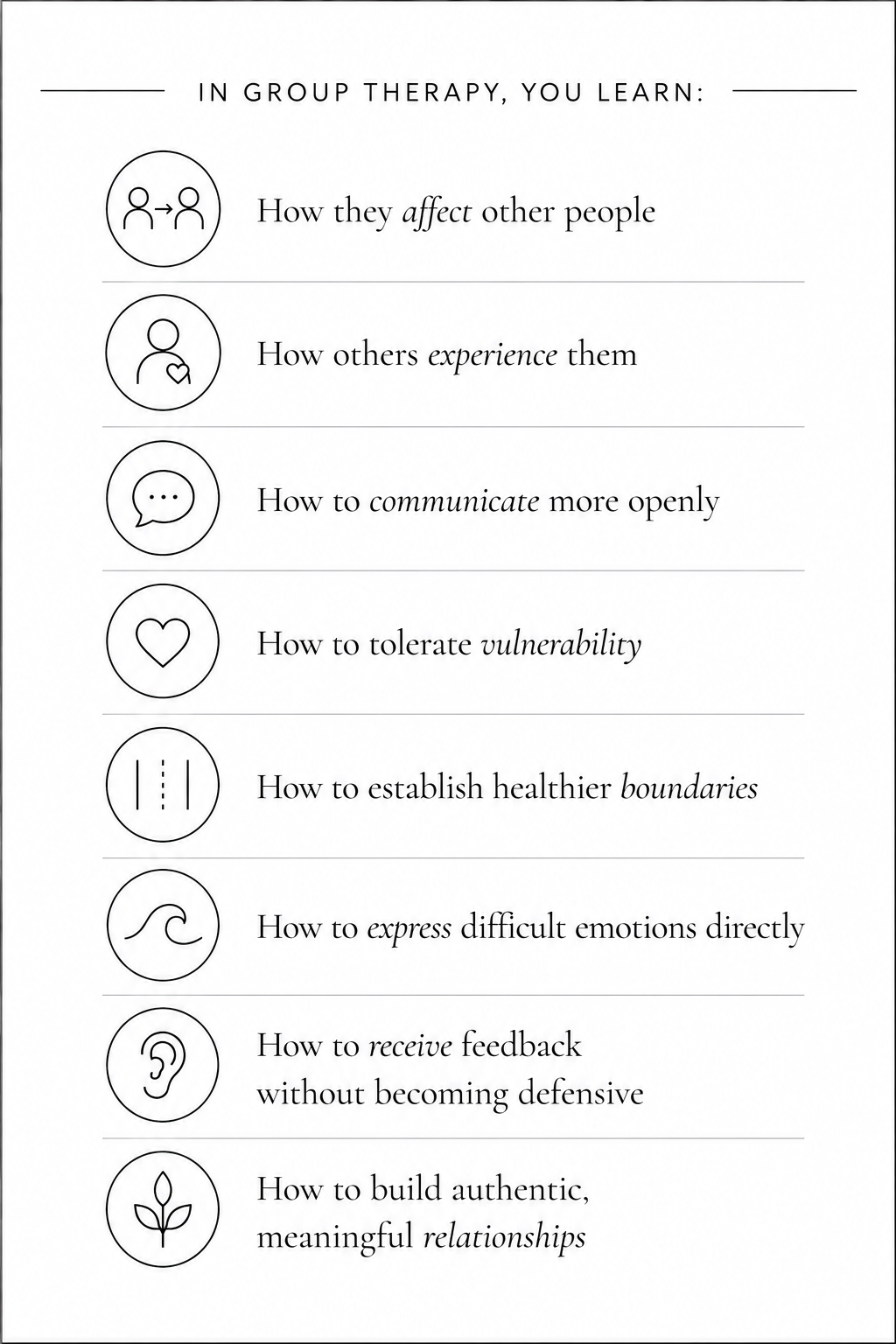
Instead of repeating old interpersonal patterns, members have the opportunity to experiment with new ones—and immediately experience different outcomes. That kind of learning is difficult to recreate anywhere else, and in fact, it is one of the few places where you have to play a role; you can truly be yourself.
Healing Isolation
Many people enter group therapy believing their struggles are unique. Thoughts such as "I must be the only one who feels this way" are common. Most people in individual therapy never get the healing experience of relating to others with similar traumatic histories or personal or mental health struggles. As members begin sharing their experiences, something remarkable happens. People discover they are far less alone than they imagined. The shame that often accompanies anxiety, trauma, depression, relationship struggles, or sexual concerns begins to soften as members recognize themselves in one another's stories. Feeling understood by people who genuinely "get it" can be profoundly healing.
Growth Beyond Insight
Insight is valuable, and understanding why you think, feel, or behave the way you do matters. But insight alone doesn't necessarily create change. Interpersonal group psychotherapy goes beyond intellectual understanding by providing members with repeated opportunities to practice healthier ways of connecting with others.Week after week, members engage in new conversations, receive feedback, repair misunderstandings, tolerate emotional discomfort, and gradually develop greater confidence in themselves and their relationships. Change becomes something you experience, not just something you understand.
Group Therapy Works Alongside Individual Therapy
Many people wonder whether they need to choose between individual therapy and group therapy. In reality, they often complement one another beautifully, but more importantly, interpersonal group psychotherapy often provides the fuel necessary to create velocity for individual or couples therapy.Individual therapy allows for deeper exploration of your personal history, internal experiences, trauma, and goals. Group therapy allows you to observe how those experiences shape your relationships with others in the present moment. Together, they create a powerful combination of insight and interpersonal growth. Kimberly uses groups to work effectively alongside psychological care or recovery programs coordinated as part of a comprehensive treatment plan.
Is Group Therapy Right for You?
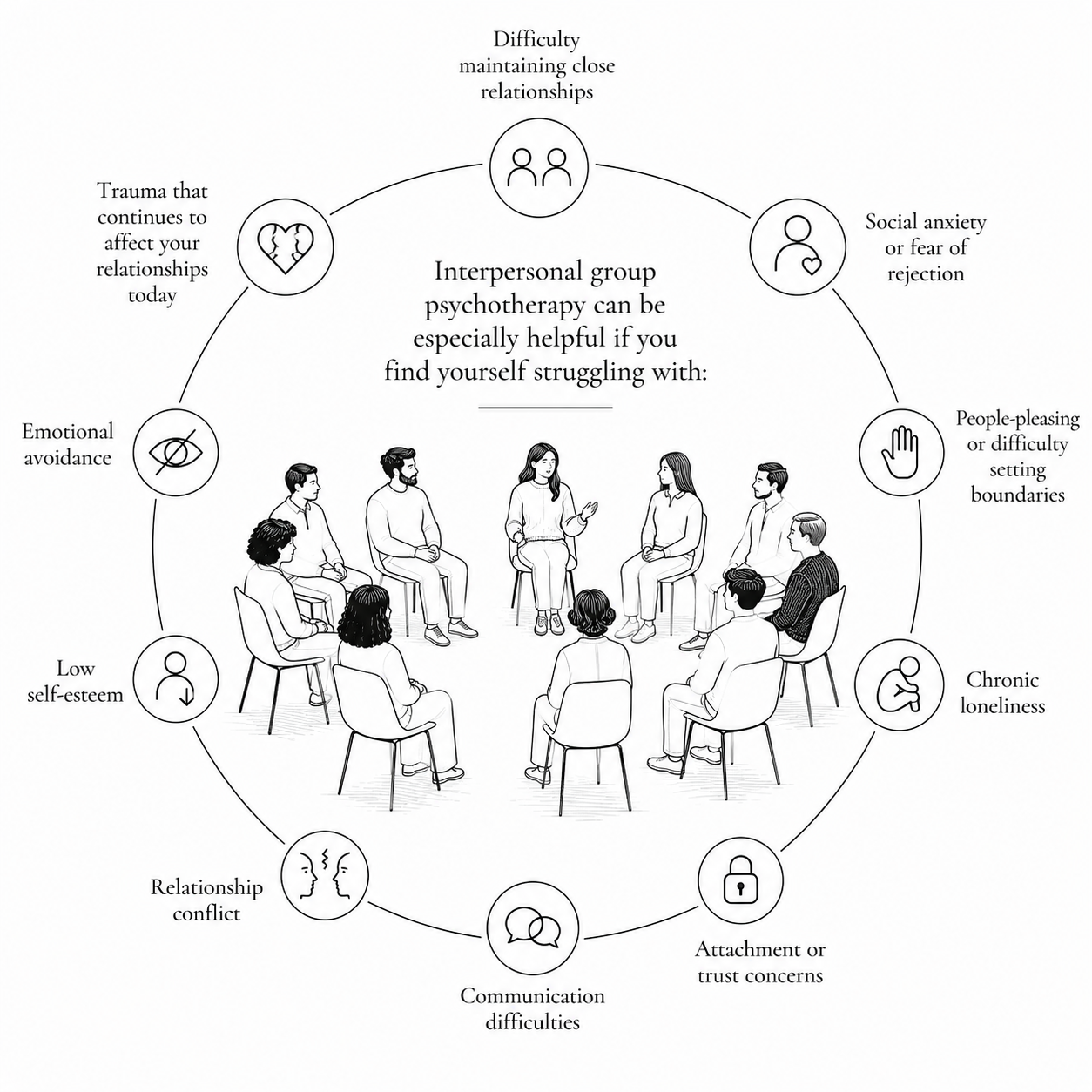
Before joining, each prospective member participates in a one-on-one pre-group consultation to determine whether the group is an appropriate fit and to discuss goals, expectations, and any concerns about beginning the process.
The Courage to Be Seen
Joining a therapy group can feel intimidating. Almost everyone worries about what others will think. Ironically, those very fears often become the starting point for profound healing. As members gradually experience acceptance, honesty, accountability, and genuine connection, they begin to rewrite long-held beliefs about themselves and others.
Over time, the group becomes more than a therapy appointment. It becomes a place where people discover they can be authentic, imperfect, and deeply connected. That experience often changes how they relate to everyone else in their lives.
If you've spent years understanding yourself but still repeat the same relationship patterns, interpersonal group psychotherapy may be the next step in your healing journey. Sometimes the greatest growth doesn't happen when someone gives you advice—it happens when you're willing to be known, challenged, and supported by others walking alongside you.
Although a bit dramatized, the series Group is a useful illustration. of what interpersonal groups look like.
Read more about Kimberly’s interpersonal psychotherapy groups. For a fuller understanding of how group functions or to prepare for group participation, review the interpersonal group psychotherapy consent form.Contact us today to get started!
Frequently Asked Questions
What is interpersonal group psychotherapy?
Interpersonal group psychotherapy uses the relationships that naturally form between group members as the main vehicle for change. Rather than only discussing the people in your life, you notice how you relate to the people in the group and practice new ways of connecting, with a therapist's guidance.
How is group therapy different from a support group?
Unlike support groups, psychoeducational groups, or process groups centered on a specific diagnosis, interpersonal group psychotherapy focuses on the relationships among members as they develop. The work happens within those relationships rather than only talking about issues from outside the room.
How is interpersonal group therapy different from individual therapy?
Individual therapy allows deeper exploration of your personal history, internal experiences, trauma, and goals. Group therapy lets you observe how those experiences shape your relationships in the present moment. Many people find the two complement each other, and group can add momentum to individual or couples work.
Can I do group therapy and individual therapy at the same time?
Yes. They often complement each other. Individual therapy goes deep on your history and internal world, while group therapy gives you a place to practice new ways of relating with others. Together they combine insight with interpersonal growth, and group can be coordinated as part of a comprehensive treatment plan.
What happens in a group therapy session?
Members build trust over time, and their everyday relationship patterns naturally emerge in the room. The group becomes a safe space to notice those patterns as they happen, experiment with new responses, give and receive honest feedback, and experience different outcomes, rather than only talking about events after the fact.
Is group therapy effective for loneliness and isolation?
Many people enter group therapy believing their struggles are unique. As members share, they often discover they are far less alone than they imagined. The shame that can accompany anxiety, trauma, depression, relationship struggles, or sexual concerns tends to soften as members recognize themselves in one another's stories.
How do I know if group therapy is right for me?
Before joining, each prospective member takes part in a pre-group consultation to determine whether the group is a good fit and to discuss goals, expectations, and any concerns about getting started. It is a chance to ask questions before committing.
Do I have to share personal details right away?
Joining a group can feel intimidating, and almost everyone worries about what others will think. Trust builds gradually. As members experience acceptance, honesty, accountability, and genuine connection over time, sharing tends to feel safer, and those early fears often become the starting point for healing.
